
Ford County's Multi-Day Arrest Log
The sheriff's page publishes no 72-hour or weekly booking log for Ford County. No archive window appears. No photo policy either. For several days of activity, dated local news has to be paired with sheriff and court records. News alone cannot confirm current custody, though. The Ford County Chronicle local archive is the natural local-news entry point.
This archive is local news, not a jail roster.
Read Ford County Blotter Entries
Read the timeline, not just the headline. A newspaper account, a jail status, and a court result are three different things, and a careful reader keeps them apart.
- Record the publication date and the incident date separately.
- Identify whether the source attributes facts to Paxton Police, Gibson City Police, the sheriff, or another agency.
- Copy the charge language as attributed. Never rewrite “arrested for” as “committed.”
- Call the Ford County Jail if current custody matters.
- Use the circuit court for hearings and later disposition.
For same-day information, the 24 Hour Arrests page offers the phone-first route. The wider arrest log serves a different job: tracing dated reports and requesting older records.
Ford Arrest Log Entry Fields
Ford County has no standard public entry format. Field sets vary by source, so the table shows what a careful reader should preserve from any dated report.
| Field | Why it matters |
|---|---|
| Source and agency | Separates reporting from official attribution |
| Incident date | Shows when the reported event occurred |
| Publication date | Shows when the story became public |
| Charge wording | Records an charge, not guilt |
| Booking or bond detail | Requires jail or court confirmation |
| Photo | No official county gallery was found |
| Disposition | Must be checked in the later court record |
A gap in one article proves little. A Ford County arrest may have gone uncovered, may sit under a different date, or may be withheld for confidentiality or safety reasons.
Paxton Arrest Stories Add Context
The Ford County Chronicle runs Paxton Police blotter pieces now and then. Examples come from 2023 and 2025. The coverage is occasional. No posting schedule exists. Neither equals a weekly log or a live jail count. Each dated story keeps an incident narrative and its agency attribution. The June 19, 2025 Paxton blotter story shows that format.
Treat the piece as historical reporting. Keep its date. Keep its attribution. A news photo, if one runs with a story, is not an official Ford County booking photograph unless the source says so plainly. That distinction matters for anyone tracing an arrest record.
Request Older Ford Arrest Records
Older Ford County arrest records start with the sheriff's office. Mary Niemann handles FOIA requests. Email her at mniemann@fcsheriff.com. The mailing address is the FOIA Officer, 235 N. American Street, Paxton, IL 60957. Calls go to (217) 379-9470, and faxes to (217) 379-9489. Describe the date range and the person. Add the arresting agency if known, and the type of record wanted. Illinois FOIA still permits redaction or withholding. Reasons include juvenile confidentiality, safety, facility security, and pending proceedings. For court follow-up, the Judici Ford case-search endpoint opens with a blank search form.
Judici is a court service, not a county booking log. Treat its case listings as court records rather than jail rosters.
Ford Arrest Archives Have Limits
The Illinois State Archives lists no sheriff booking-photo series among its Ford County holdings. That gap proves nothing. Records may sit with the sheriff. They may rest with the court, another custodian, or a series filed under a different title. Illinois sets no single retention period for local records. The State Archives local-records FAQ explains that retention depends on the record itself and an approved Application for Authority to Dispose. Photographographs count as records in any format. The Local Records Commission approves any disposal. To check whether a schedule covers a specific sheriff series, call the records-management office at (217) 782-7075 or (217) 782-7076. Archive retention says nothing about present jail status.
Unofficial Ford Arrest Archives
Mugshots.com keeps a Ford County archive. It is not an official source. Entries can be stale, incomplete, or wrong. RecentlyBooked's Illinois directory, for its part, lists no Ford County section. Neither site can confirm a current arrest, and the RecentlyBooked Illinois directory makes that gap plain.
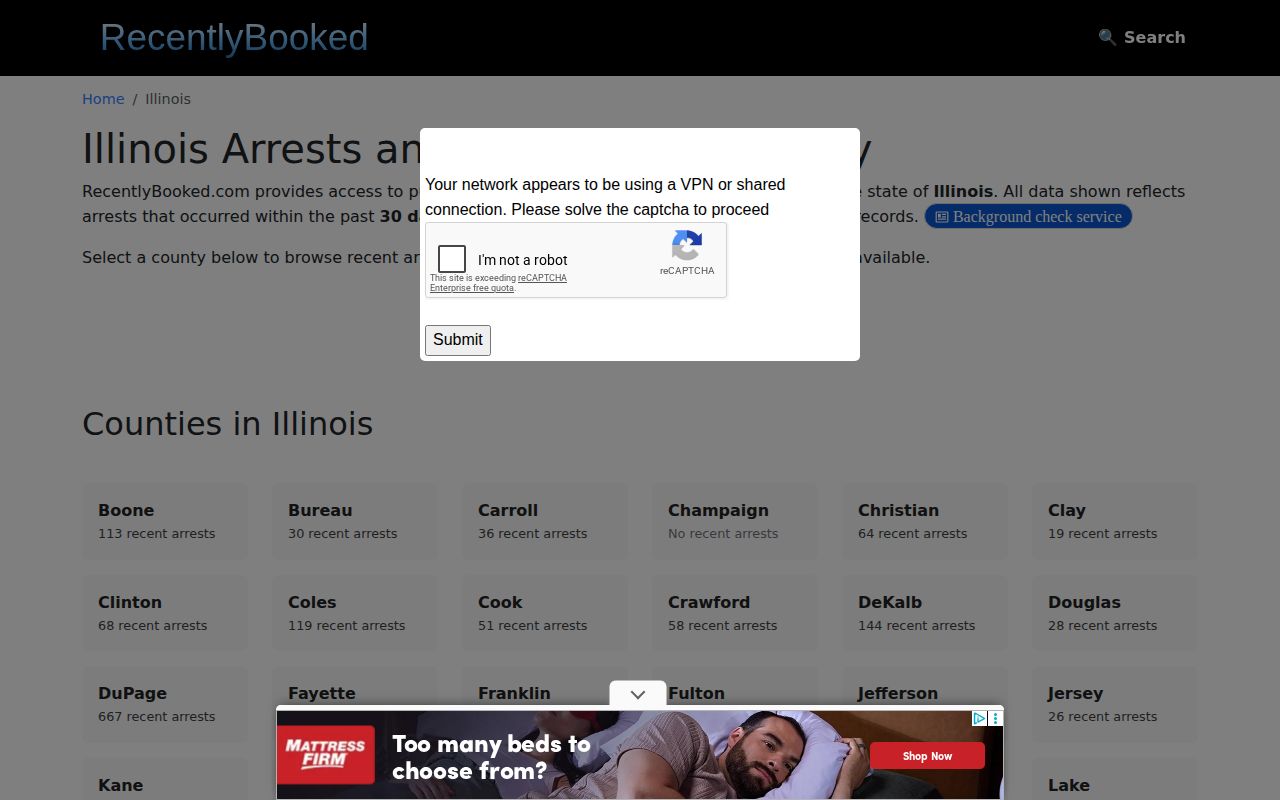
The directory appears here only to map the unofficial landscape after official sources. It is not a Ford County record.
Ford Arrest Charges Are Allegations
Names get mixed up easily. Similar names and stale archive labels cause misidentification all the time. Charges can also be amended, dismissed, or sealed. Verify identity with the arresting agency, custody with the jail, and outcome with the court disposition.
- Blotter
- A dated account of incidents or police activity, not necessarily a complete jail list.
- Bond
- A court-set condition connected with release.
- Disposition
- The later resolution recorded by the court.
- Expungement
- A legal process that may remove or restrict eligible records under a court order.